
Key Takeaways
- A continuity plan is an emergency backstop; a succession plan is a multi-year strategy to transfer operational knowledge and client relationships. Having one does not mean you have the other.
- Client relationship handoffs can be an important source of risk during succession transitions. Inconsistent client experiences may create added friction when a successor cannot readily replicate the founder's manual, undocumented workflows.
- Operational transferability can be one consideration in succession and due diligence. Standardized, system-driven client deliverables may help firms reduce key person dependency and support greater continuity across advisors.
- Internal succession can offer continuity advantages but may require a longer timeline, successor development, and careful planning.
- A phased client communication approach can help firms manage multiple changes more deliberately during a transition.
Many financial advisors are thinking about eventual transition planning, yet the more important question is often how prepared a firm is to execute that transition in practice. Succession planning discussions can focus heavily on transaction mechanics, including valuation and legal agreements.
Client relationship handoffs can also be an important consideration during a transition, particularly when clients are being introduced to a new advisor and a new operating rhythm at the same time.
Succession planning is not only a transaction challenge; operational readiness is another important part of the equation. Operational transferability can influence how readily a practice transitions, especially when workflows, portfolio data, and client-facing materials are consistent and repeatable. Platforms like VRGL that standardize how portfolio data is analyzed and presented across advisors can help reduce the operational gap a successor may need to navigate, making the handoff less dependent on one person's institutional memory.
This guide moves beyond deal mechanics to focus on operational factors that can influence transition readiness. We will distinguish continuity from succession, examine common handoff challenges, compare considerations in internal versus external paths, and explore how portfolio data readiness can be an often overlooked consideration in transferability.
Continuity Plans and Succession Plans Solve Different Problems
A continuity agreement and a succession plan address different needs and should not be treated as interchangeable. A continuity plan is generally designed to address unexpected disruption, while a succession plan is a broader, longer-term strategy for transferring relationships, responsibilities, and operational knowledge over time.
A continuity plan may address events such as the death, disability, or incapacity of a key principal. Depending on how it is structured, it may identify a temporary or permanent successor, outline certain transition procedures, or reference buy-sell arrangements. It is an important backstop, but it is not the same as a full succession strategy. At a high level, it answers the question, "What happens if?"
Consider a solo advisor with $150M in AUM who has a signed continuity agreement naming a colleague as emergency successor. This advisor's investment process, however, exists only in their head and on a local desktop. Client reports are assembled manually, and there are no standardized templates. If that advisor becomes incapacitated, the continuity agreement may help establish who steps in, but the colleague could still inherit a book of business that is difficult to operate. The workflows are not documented, the data is not readily transferable, and maintaining continuity for clients may require significant reconstruction of the firm's day-to-day processes.
A broader succession plan, by contrast, is a proactive strategy. It addresses not just who takes over, but how the practice functions day to day. It can encompass practice valuation, successor development, client segmentation for transition, and a timeline adapted to the firm's needs. Succession planning is increasingly discussed in the industry as one way firms may consider client interests through a transition. How a firm's specific obligations apply depends on the applicable regulatory and professional frameworks, and firms should consult qualified counsel on their specific situation. A continuity agreement names a backup; a succession plan builds a practice that can operate with greater continuity over time.
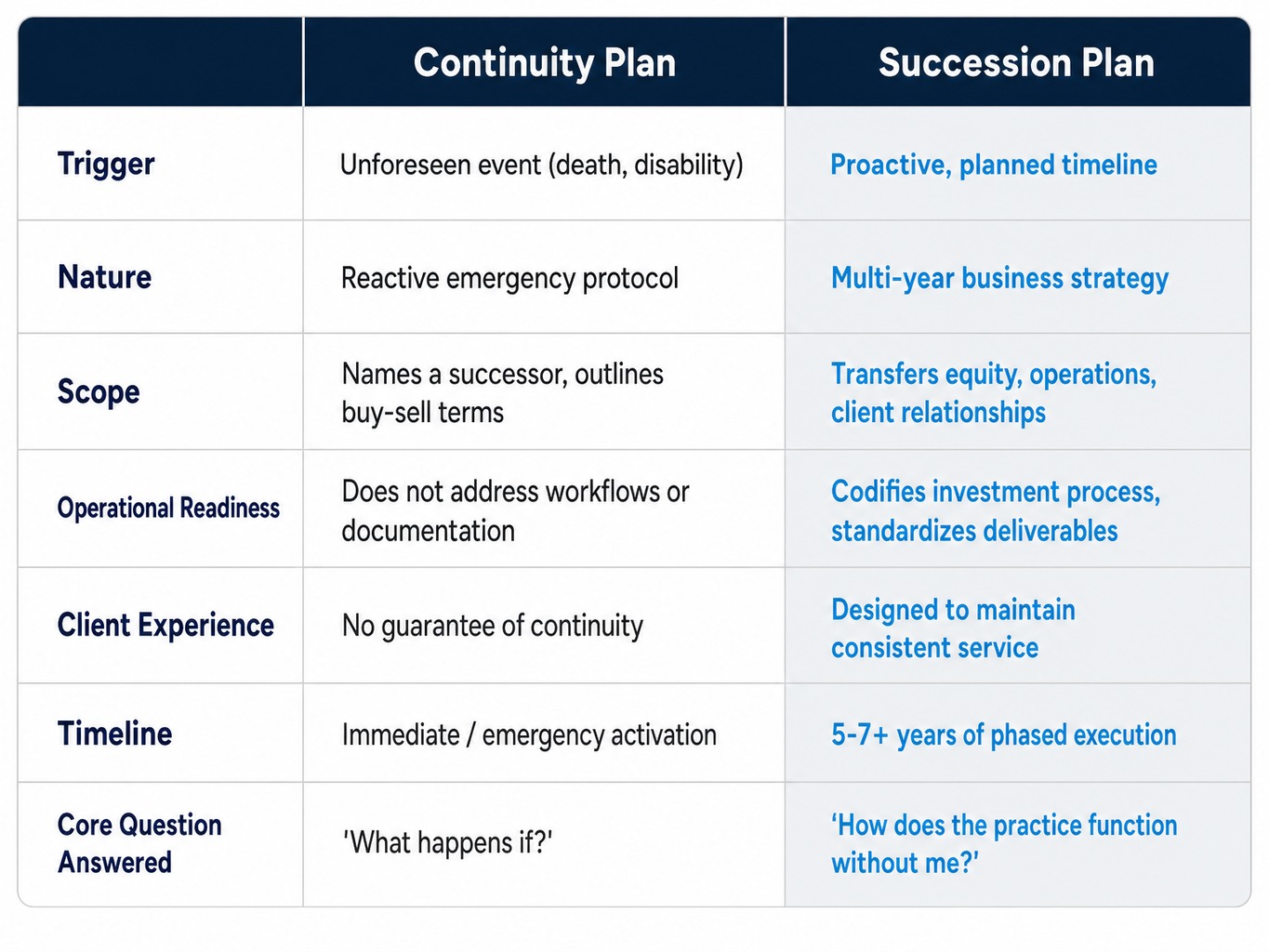
Having a continuity plan does not mean you have a succession plan.
Why Client Relationship Handoffs Matter in Succession Transitions
Discussions around succession planning often focus on deal structure, valuation, earnout terms, and financing options. Those considerations can be important, but so can the quality of the client handoff. Changes in recurring client relationships and continuity of service may affect how a transition unfolds and can be relevant to transaction economics.
Even when a transaction is thoughtfully structured, firms may still need to manage how clients experience the transition in practice. If the recurring client experience changes materially during that period, both buyer and seller may face added uncertainty around continuity, integration, and post-close expectations. In that sense, succession risk is not only about the deal itself, but also about what clients experience after the transaction.
The Advisor-Dependent Practice Problem
One challenge during succession is that the client relationship may be built around an individual advisor's personal judgment and manual workflows, rather than a repeatable firm process. Think of a founding advisor who runs portfolio reviews from memory, builds proposals in spreadsheets, and communicates performance through ad hoc emails. Their personal touch may be a strength in the relationship, but operationally it can create significant key person dependency.
When a successor takes over, clients may encounter a noticeably different interaction. The reports may look different, the meeting cadence may change, and the language used to describe risk may feel unfamiliar. This does not necessarily reflect on the successor's capability. It may simply indicate that the firm lacks a consistent, documented framework for how advice is prepared and presented. In due diligence, workflow consistency may be relevant to how a prospective buyer evaluates operational integration, key person dependency, and the effort required to maintain a consistent client-facing experience after close. Practices where the client experience relies heavily on one person's habits may be evaluated differently from practices where that experience is supported by more transferable systems.
Read more: How to Create Winning Proposals: 3 Tips for Advisors
What Clients Actually Experience During a Transition
Clients may experience a transition primarily through changes in service, communication, and deliverables rather than through the transaction mechanics themselves.
Imagine a high-net-worth client who has received detailed, professionally branded portfolio reviews every quarter from their founding advisor. After the transition, the successor, using different tools and processes, provides a generic, system-generated report with different risk metrics. Even if the underlying investment management is unchanged, the client may experience the relationship differently. Changes in reports, meeting cadence, or terminology can create a noticeable shift in the client experience.
This is fundamentally an operational issue. Firms that have standardized how portfolio data is analyzed, how proposals are structured, and how reports are branded give successors a clearer framework for maintaining continuity of experience from day one. The successor can step in and produce deliverables that more closely resemble what the client is used to, because the process is owned by the firm, not only by the individual. Repeatable workflows can help firms maintain greater consistency during a succession transition.
Internal Succession vs. External Sale: Comparing the Economics
The decision between developing an internal successor and pursuing an external sale is a defining moment for any advisory firm. These are not just different strategies; they have different economics, risk profiles, and operational demands. Neither path is universally better. The right choice depends on the firm's size, the depth of its G2/G3 advisor cohorts, and the founder's personal timeline and goals.
An external sale may offer a more direct path to liquidity in some circumstances. Internal succession, on the other hand, can offer continuity advantages, but it generally requires a longer planning horizon and a stronger internal bench. An owner of a $300M AUM firm with two senior associates ready for an equity path is facing a different set of considerations than a solo advisor with $120M AUM and no clear internal heir.
Equity Glide Paths and Internal Successor Development
Internal succession is often approached through an "equity glide path," where ownership transitions incrementally to next-generation advisors over time. Structures vary by firm and may involve phantom equity, deferred compensation arrangements, or direct equity purchases financed in different ways. The exact approach depends on the firm's goals, capital structure, and advice from legal, tax, and financial professionals.
Potential advantages can include continuity of relationships, preservation of firm culture, and a clearer career path for internal talent. However, the demands are meaningful. It requires a multi-year commitment, and internal successors need to be prepared not only to manage client relationships but also to assume broader business responsibilities. The details of any protections, incentives, or transfer terms vary materially by firm and are best evaluated with qualified professional guidance.
External Sales, Aggregators, and Deal Structures
The external sale landscape is diverse, including direct sales to another advisor, tuck-in acquisitions by larger RIAs, or sales to roll-up aggregators and private equity-backed platforms. These transactions may be structured with combinations of upfront payments, seller financing, and contingent consideration, depending on the parties and the deal.
External deals may offer a faster path to liquidity in some cases. Financing options may include bank financing, SBA-backed structures where eligible, or buyer-provided capital. Some platform and aggregator models may also affect transition timelines, although structures vary significantly by acquirer and situation. This path can also involve tradeoffs, including the possibility of operational changes that affect how clients experience the firm after the transaction.
Earnout provisions are one example of how post-close performance expectations may be handled in an external sale. The exact structure, measurement period, and operational responsibilities can vary considerably. For that reason, how continuity is maintained during the transition may be an important consideration when evaluating an external deal.
How Workflow Consistency Supports Succession Readiness
Practice valuation conversations often focus on revenue multiples, client demographics, and AUM. Operational infrastructure can also be relevant in succession planning and due diligence. The transferability of a firm's portfolio data, analytics workflows, and client-facing materials can be an important operational consideration when firms evaluate transition readiness.
Consider two advisory practices, each with identical revenue and AUM.
- Practice A relies heavily on the founder's individual workflows. Client portfolio data is siloed in spreadsheets, proposals are built manually for each prospect, and quarterly reports are assembled on an ad hoc basis. The client experience may depend substantially on one person's habits and institutional knowledge.
- Practice B uses a structured, repeatable workflow. It has a system for extracting and consolidating client statement data, running objective quantitative portfolio analysis , and producing consistent, branded, and compliant proposals and reports.
A buyer evaluating Practice A may focus more closely on operational integration, documentation, and key person dependency. Where workflows are difficult to transfer, the buyer may need greater confidence around how the client experience will be maintained after the transition.
A buyer evaluating Practice B may see a system of work that is easier to understand and carry forward. When workflows, data inputs, and client-facing materials are more clearly documented, a successor may be better positioned to maintain continuity from day one.
Investing in portfolio data readiness and workflow consistency is not just an operational improvement. It can also support how a practice prepares for succession over time. The same repeatable processes that support more efficient meeting preparation and consistent client-facing deliverables today may also reduce key person dependency down the line. Firms looking to scale a financial advice practice will often find that the same operational discipline that supports growth can also support transferability.
VRGL can support the operational consistency and transferability that may be relevant during succession planning. By offering a configurable system of work that moves from automated statement extraction to analytics, proposal generation, and ongoing client reporting, VRGL helps firms operationalize consistency. Advisors can deliver objective, branded deliverables that support a more consistent client experience. For enterprise firms, firmwide governance and controlled templates can help reduce the client experience's dependence on any single advisor's habits.
Read more: VRGL Launches Client Transition and Proposal Offering | VRGL
See how VRGL helps firms build repeatable, transferable advisory workflows
Supporting Client Continuity Through Succession Communication
Client communication is the moment operational readiness becomes visible to the people who matter most. A thoughtful communication plan can help create greater continuity and clarity during a transition. When several changes happen at once, clients may experience additional disruption.
A common pattern is to treat communication as a single event, a generic announcement letter. This can make the transition feel more abrupt than intended. Imagine a firm that announces a founder's retirement, introduces the successor, and changes the reporting format all in the same quarter. Clients are hit with three changes at once: personnel, process, and deliverables. It can feel abrupt and unsettling.
A more deliberate approach treats communication as a phased process designed to normalize the transition over time. Contrast the previous scenario with a firm that introduces the successor gradually over a defined period. The successor's name first appears on co-branded reports. Then, they begin co-leading client meetings. All the while, the format and quality of the client-facing materials, the proposals, the analytics, the quarterly reviews, remain consistent. The main change clients experience is the person.
One useful principle is to separate the personnel change from any operational changes so that clients absorb one shift at a time. Client segmentation also plays a role, and households often vary in the level of personal attention they need. Segmenting by AUM, relationship tenure, or complexity can help the founding advisor prioritize higher-touch outreach for the relationships most central to the firm's transition planning, well before the formal transition.
An Illustrative Phased Succession Timeline
A common challenge in succession planning is not only starting late, but starting without a phased structure. An advisor who plans to retire in five years but has no defined milestones between now and then may have a deadline rather than a practical transition roadmap. A phased approach can help firms break succession planning into more manageable stages.
While every practice is different, one illustrative timeline can be broken into three phases.
-
Phase 1: Preparation. This is the foundational stage. It may begin with a formal practice valuation to establish a baseline. The focus can then shift to operational documentation and standardization. This is often when firms begin to codify elements of the investment process, document workflows, and improve consistency in client deliverables. The firm may also begin evaluating whether an internal or external succession path is the better fit.
-
Phase 2: Active Transition. This phase is about execution. If the path is internal, a successor may be formally identified and begin taking on expanded responsibilities over time. If external, this is often when deal discussions become more active. This may also be when the successor is introduced to clients, first through co-branded materials and then through joint meetings. Client-facing responsibilities may be shifted gradually, sometimes beginning with smaller or less complex relationships.
-
Phase 3: Completion. In the final phase, the founder may step back from day-to-day client-facing work and move into a more limited strategic or advisory role. The successor assumes broader operational responsibility. For sellers, this may also be when final earnout or equity transfer milestones are completed. The exact timing and sequence vary widely depending on the firm's structure, successor readiness, and transaction approach.
Mapping out a multi-year plan with specific milestones can help turn succession from a future event into a more structured, present-day planning process.
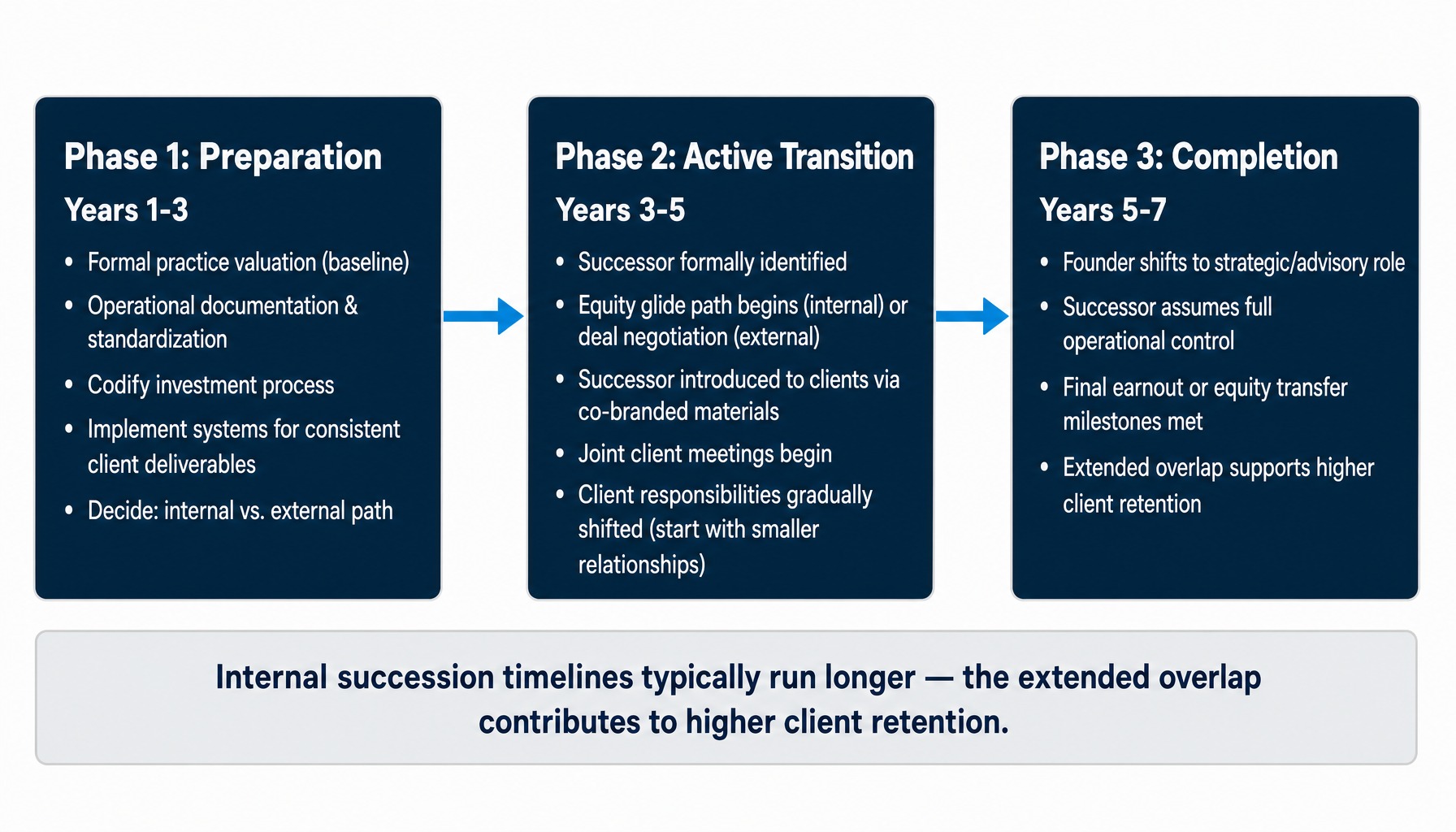
A phased timeline can help turn succession planning from a future deadline into a more structured process.
Conclusion
Financial advisor succession planning is one of the most significant strategic challenges a firm owner may face. Yet the conversation is often shaped by the mechanics of the transaction. Even when deal terms are carefully structured, firms may still need to navigate how clients experience the transition itself.
The value of an advisory practice is not only in its AUM or recurring revenue, but also in its ability to deliver a consistent, high-quality client experience. When that experience depends heavily on the manual habits of a single advisor, it can be more difficult to transfer. When it is supported by repeatable systems and workflows, a successor may be better positioned to inherit and continue that experience.
Distinguishing a continuity backstop from a broader succession strategy, understanding the considerations involved in internal versus external paths, and executing a thoughtful client communication plan are all important components. But they also depend on a foundation of operational readiness. Beginning well before an anticipated transition can give firms more time to address operational readiness. Firms that invest in making their practice more transferable today may be better positioned when the succession moment arrives.
This article is for informational purposes only and does not constitute investment, legal, tax, or compliance advice. Financial advisory firms should consult with qualified legal, tax, and compliance professionals when evaluating succession or transition options.
Frequently Asked Questions
What happens to my clients if I die or become disabled without a succession plan?
Without a documented continuity or succession agreement, client servicing and operational responsibility can become more complex during a period of uncertainty. What happens next can vary significantly based on the firm's entity structure, custodial relationships, governing agreements, registration status, and applicable legal and regulatory requirements. Because these situations are highly fact-specific, firms should consult qualified legal, compliance, and business continuity professionals.
Can I use an SBA loan to finance buying a financial advisory practice?
SBA 7(a) financing may be available for certain advisory-practice acquisitions, subject to lender and SBA eligibility requirements. Availability, structure, and underwriting considerations can vary based on the buyer, the firm, and the transaction. Advisors considering this path should work with qualified lenders and professional advisors who understand the specifics of advisory-practice transactions.
How do I value goodwill versus hard assets in a wealth management practice sale?
In advisory-practice transactions, value is often tied substantially to intangible factors such as client relationships, recurring revenue characteristics, and operational continuity, while hard assets may represent a smaller portion of the overall transaction. That said, valuation and purchase-price allocation depend on the structure of the deal and the analysis performed by valuation, tax, and legal professionals. Firms should rely on qualified experts when evaluating these questions.
How do RIA aggregators and roll-ups factor into succession planning?
Aggregators and roll-up platforms can offer an alternative to traditional one-on-one sales by acquiring practices and integrating them into a larger entity. Depending on the model, this may affect liquidity timing, operational support, autonomy, technology choices, and the client service experience after the transaction. Because aggregator models vary significantly, firms should evaluate the specific tradeoffs of any potential partner.
How do I structure an earnout in a financial advisor succession deal?
An earnout ties a portion of the purchase price to defined post-closing conditions or performance measures. The specific structure, measurement period, and criteria can vary materially from one transaction to another. Because these terms can affect both economics and transition responsibilities, advisors should work with qualified legal, tax, and transaction professionals when evaluating earnout provisions.
What are the tax implications of selling a financial advisory practice?
The tax treatment of a practice sale can vary based on several factors, including how the transaction is structured and how the purchase price is allocated across different categories. These decisions carry significant tax implications and depend on individual circumstances. Advisors are encouraged to work with qualified tax professionals experienced in advisory practice transactions.